How to Measure Your Sit Bones at Home
Measure your sit bones at home with cardboard, a hard chair, and five minutes. Get the one number that makes saddle shopping actually make sense.
Why this number is worth five minutes
Saddles come in widths. Most of us didn’t know that when we bought our bikes — and most complete bikes ship with one width, chosen for an “average” rider who may not share your proportions.
Your sit bones (the two bony points you feel when you sit on a hard bench) are what should carry your weight on a saddle. If the saddle is narrower than your sit bones, they hang off the edges and soft tissue takes the pressure instead. That’s the discomfort a lot of riders quietly assume is just part of cycling. It isn’t.
So before you fall down a saddle-review rabbit hole: measure. It turns saddle shopping from guesswork into a shortlist.
What you need
- A piece of corrugated cardboard (an old shipping box is perfect)
- A hard, flat chair or bench — no cushions
- A ruler or tape measure
- Optional: a piece of chalk or a marker
The steps
- Set up. Lay the cardboard flat on the hard chair.
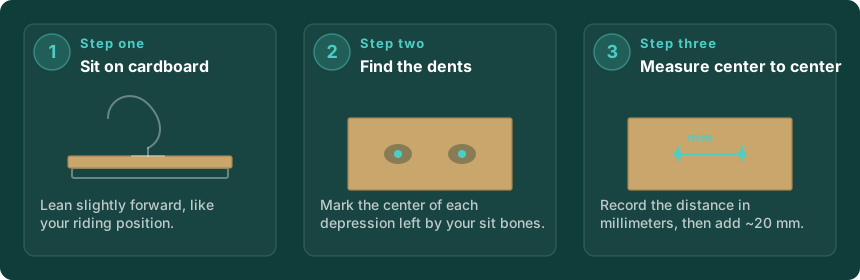
- Sit like you ride. Sit on the cardboard, feet flat on the floor, and lean your torso slightly forward — roughly the angle you’d hold on your hoods or gravel bars. Hold it for about 30 seconds. Feel free to press down a little.
- Find the dents. Stand up and angle the cardboard toward a light. You should see two shallow depressions. If they’re faint, trace around them with chalk or run a marker gently over the surface — the dents will show up as gaps.
- Mark the centers. Put a dot in the middle of each depression.
- Measure. Measure the distance between the two dots in millimeters. That’s your sit bone width.
What to do with your number
A common approach: sit bone width + ~20 mm ≈ saddle width starting point. The extra margin gives your sit bones a platform to rest on rather than balancing on the edges.
For reference, most riders measure somewhere between about 100 and 140 mm — and yes, the ranges for women and men overlap a lot. Women’s sit bones are wider on average, which is why stock saddles (often on the narrow side) fail more women than men. But your number is your number. Measure, don’t assume.
Once you have it, the full saddle shopping guide is here: Your Saddle Isn’t the Problem. The Wrong Saddle Is..
Frequently asked questions
What if I can't see the dents in the cardboard?
Use softer cardboard (single-wall corrugated works better than heavy double-wall), sit for a full minute, and press down deliberately. You can also lay a sheet of aluminum foil over a carpeted stair and sit on that — the foil holds the impression well.
Do I add 20 mm or 25 mm?
Treat it as a range, not a rule. Around 20 mm is a common starting point for a road or gravel position; if you ride very upright, adding a bit more often works. The measurement narrows your options — a test ride makes the final call.
Is a wider saddle always more comfortable?
No — too wide causes its own problems, like inner-thigh rubbing and chafing as you pedal. The goal is support under your sit bones, not maximum surface area.
Do women need women-specific saddles?
Not necessarily. What matters is whether the saddle's width and shape match your measurements and position. Plenty of women ride unisex saddles happily. Women-specific models exist because the average stock saddle skews narrow — not because your bike needs a label.